
How the East Baton Rouge Parish Court Calendar Works
Two kinds of schedule exist here. The 19th Judicial District Court posts civil and criminal duty calendars, which are public rotation schedules showing which division or section covers duty. Those help you learn the court's calendar structure. They are not a case-by-name setting list, so a notice, citation, or docketed court event still anchors any individual East Baton Rouge Parish court date.
For a 19th JDC matter, the ClerkConnect Court Event Inquiry is the remote route to date-related case events. Note that it sits behind a login. City courts run separately. Baton Rouge City Court sets its own rules and notices, while Baker and Zachary city cases each have their own court contacts.
East Baton Rouge Parish Duty Calendar Rules
The official 19th JDC duty-calendar hub gathers civil duty schedules, criminal duty schedules, holiday rotations, and commissioner duty material. Work is organized by section and period. No promise comes with it that every motion, trial, or hearing in your case appears publicly.
Take the 2026 criminal schedule. It runs as a weekly rotation. Columns cover duty date, next date, misdemeanor section, jury-misdemeanor section, and holiday coverage. One listed section is marked TBD. That caveat alone tells you to treat the duty material as a section guide, not a final court-date confirmation.
Start any rotation question at the duty-calendar landing page. It is the official home for East Baton Rouge Parish court rotation PDFs.
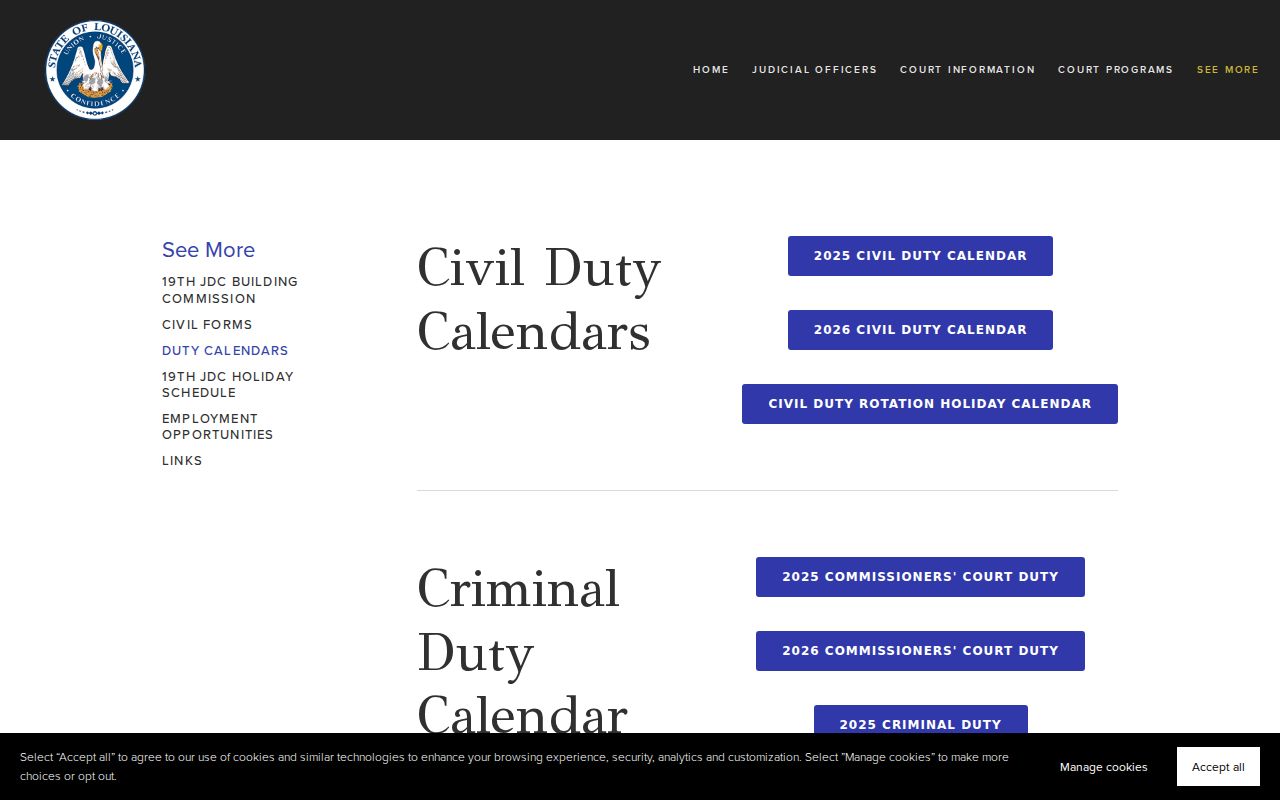
The civil and criminal links make the split plain: a published rotation is one thing, a case-specific docket event another.
East Baton Rouge Parish Court Date Lookups
Go to the strongest source first. A citation, summons, notice, or prior order should state the court, date, and time. It should also state the case or docket number. That is your foundation. For eligible parish records, the clerk's Court Event Inquiry serves as the official remote endpoint. Its pre-login screen does not disclose the exact date-search fields. So no field-by-field public lookup can be promised.
- Read the notice or citation and write down the court, date, division, and case identifier.
- Use the ClerkConnect event route if the matter belongs to the parish clerk system and remote access is available.
- Check the public duty or holiday calendar only for rotation and closure context.
- Use the assigned judge or division page for office information when the case identifies a section.
- Call the responsible clerk department or city court to confirm a date that remains unclear.
One call often settles a date question. The clerk lists Traffic at (225) 389-4761, Criminal Records at (225) 389-3964, Suit Records at (225) 389-3972, and Duty Court at (225) 389-4935.
East Baton Rouge Parish Date Sources
Three signals can disagree: the original notice, the docket or minute entry, and a published court calendar. The notice shows the date the parties received. A docket or minute entry may reflect later events. The public rotation calendar shows duty coverage. Trust the newest case-specific record over an older paper or a general schedule.
City-court matters take a separate check. Baton Rouge City Court's Criminal/Traffic department answers at (225) 389-5294. Baker and Zachary each run their own routes. When the issuing court is unclear, confirm that first. Do not assume the case sits on a parish calendar.
For a remote search, the ClerkConnect Court Event Inquiry shell is the local portal route. It serves a subscribed East Baton Rouge Parish setting search.
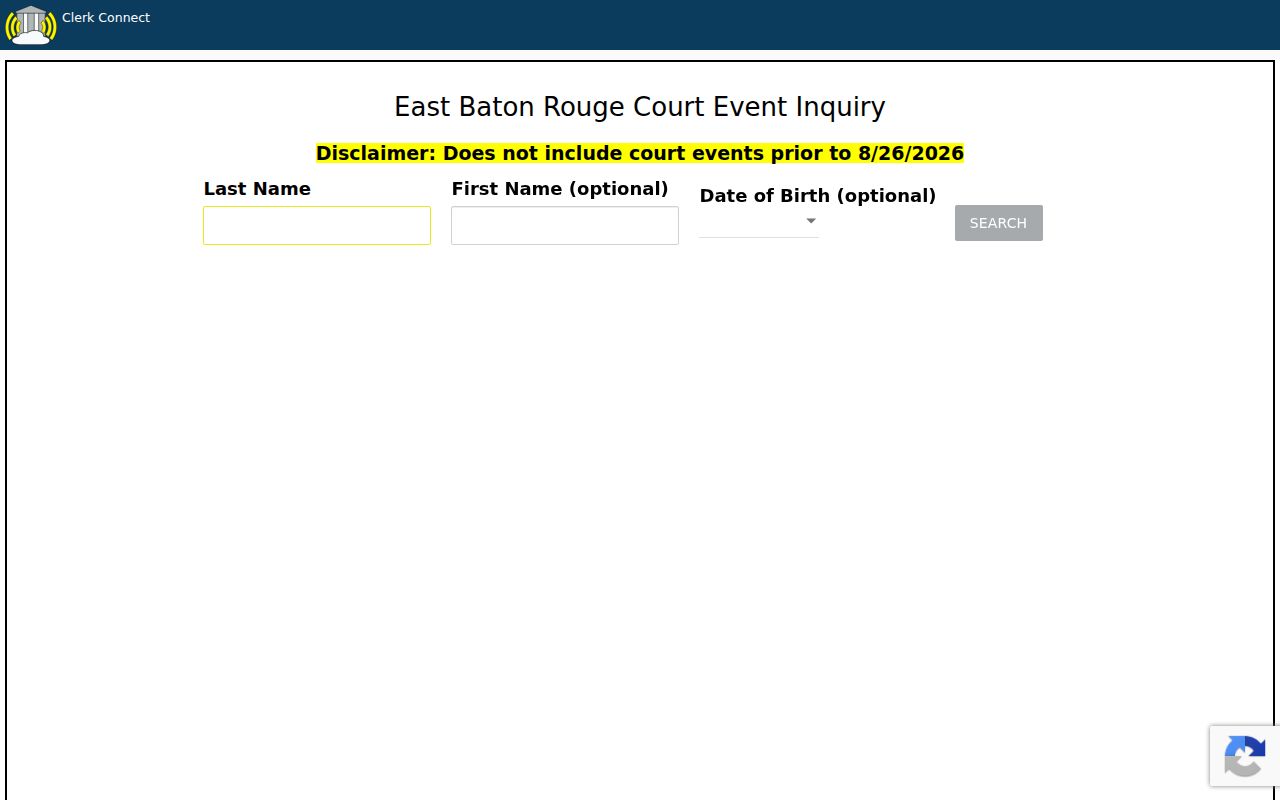
The login screen draws the line clearly: remote event access and public duty calendars are two different calendar tools.
Court Settings: What Each Field Means
A court setting is a scheduled event. It is tied to an identified case. Read it as a whole. Court or section, date, time, courtroom, judge, and setting type belong together. The public duty PDF does not carry all of those case fields. For the complete setting, you need a case notice or a detailed event record.
| Date and time | The assigned hearing information. Confirm the newest case-specific source. |
|---|---|
| Court or section | The 19th JDC division, city court, or other court that will hear the matter. |
| Judge and courtroom | Often confirmed by the assigned division page or notice, not by a general rotation list. |
| Setting type | Examples include arraignment, status conference, motion hearing, pretrial, trial, or docket call. |
| Case number | The identifier that ties the setting to the correct case rather than a broad calendar row. |
Note: A setting records a court event only. It does not reveal the final outcome, or whether a later reset changed anything.
East Baton Rouge Parish Traffic Date Requests
Need a new traffic court date in East Baton Rouge Parish? The 19th JDC offers online resolutions for exactly that. The same portal handles compliance review and defensive-driving paperwork. It is open around the clock. Even so, the court, not the website, makes the call and sends the notice. If you use the reassignment route, expect contact by email within three business days.
Do not confuse paying online with asking for a new date. Some parish traffic cases are already past their court date. For those, the clerk says online payment is not available. An extension must be requested in person instead. Anyone who wants to contest a traffic matter should follow the court's current instructions. Keep the citation close. The clerk's reassignment request page spells out the response time for these traffic date requests.
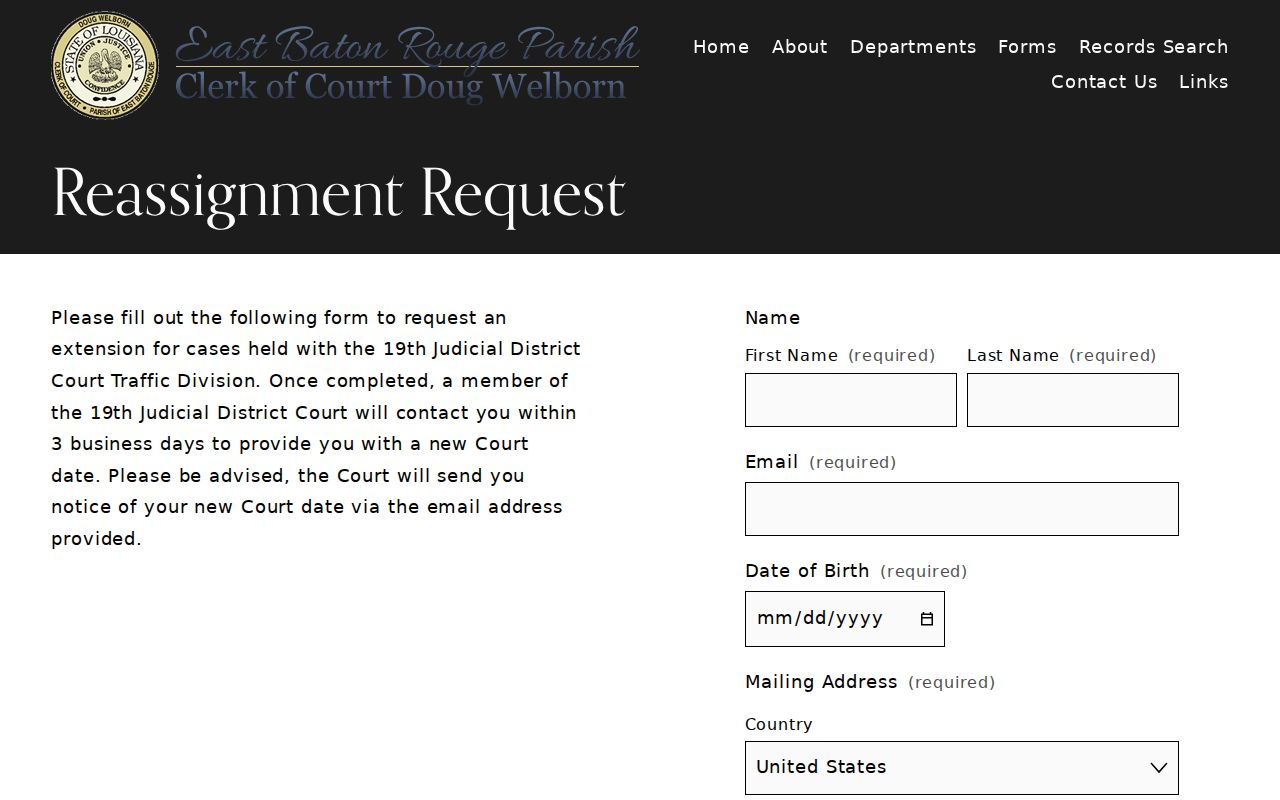
The online form is a request channel, not a self-issued replacement date.
When a Court Date Moves
A reset or continuance only shifts a court date. The case itself stays open. Nothing about the change tells you it was dismissed, decided, or forgotten. Check for a later notice, minute, or docket entry, or confirm directly with the assigned court. Old events sometimes linger in the case history. When they do, a schedule can list more than one date for the same matter. Holiday closures can also move timing. The 19th JDC posts its holiday and court information, while Baton Rouge City Court keeps a separate annual holiday schedule, so confirm any closure with the court that owns the case.
East Baton Rouge Parish City Court Date Rules
For many traffic matters, Baton Rouge City Court builds everything around the citation date. An OTA violation requires an appearance. Section A offenses follow a 60-day arraignment rule. That covers hit and run, failure to report an accident, and driving under suspension or revocation. The clock runs from the day after issuance or arrest, with a next-legal-day adjustment when needed. An OTA date must fall at least 28 days after issuance. These are city-court rules. They are not a universal parish calendar. A citation from another agency may route to the parish traffic department instead, so confirm the issuing agency before applying any date rule. The 19th JDC online-resolution page covers both options.
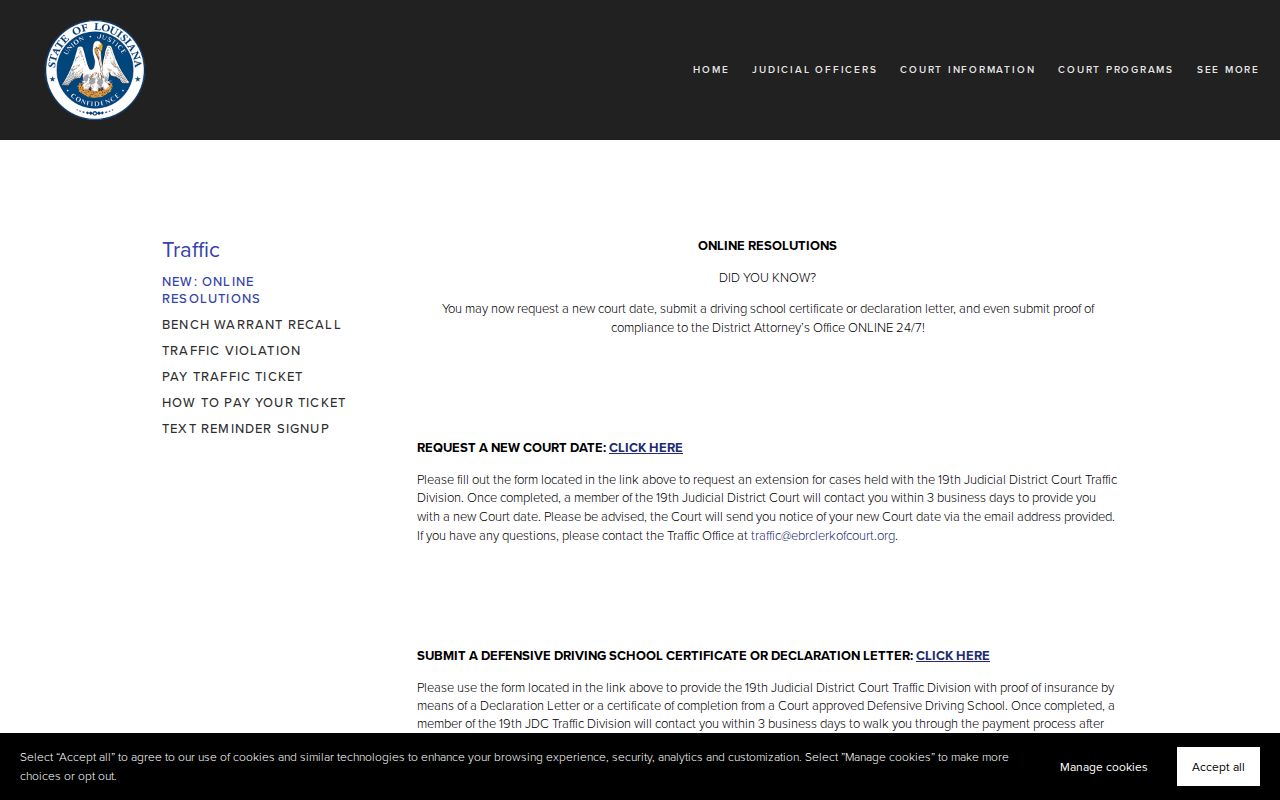
A traffic date inquiry does not always change the calendar instantly. Often the court itself must respond first.
Missed Settings and What Comes Next
A missed setting does not end the case. Read the current docket or notice. Then call the East Baton Rouge Parish court that owns the matter. For parish traffic, use the clerk's traffic contact or the new-date process when one applies. Criminal or civil matters go to the department matching the record type. Give the case number, section, and date.
Act promptly: A missed setting can lead to a new notice, a reset, or other court action. The current case record and the responsible court are the sources that can confirm the next step.
Have the identifier from your notice ready when you call. A general duty calendar cannot resolve a missed setting, since it never replaces the individual docket.
East Baton Rouge Parish Court Schedule Limits
East Baton Rouge Parish schedules live in many places. Case records hold some. Division pages, duty PDFs, and separate city-court channels hold the rest. The duty documents only say what they say. They are not a full searchable calendar. ClerkConnect works as a paid remote option, and the clerk counter remains the in-person route for records held by the parish system. When a date question stays open, keep the original notice. Ask the responsible court to confirm the current setting. That beats guessing from a broad schedule or a stale calendar copy. Individual 19th JDC judge pages can add courtroom, suite, judicial-assistant, and court-reporter details, plus conference practices or remote meeting instructions. Those details help aim a calendar question once the case section is known. They never override a later notice, docket entry, or instruction from the assigned division. The official source is the record for that matter.